



How Do Art Galleries and Private Collections Offer Guided Viewing With a Tour Guide System
2026-10-27
A visitor stops in front of a painting, reads three lines on the wall label, and moves on. The curator knows there is a story behind the brushwork, the sitter and the year it was painted, but a label cannot carry it, and a guide cannot be everywhere at once.
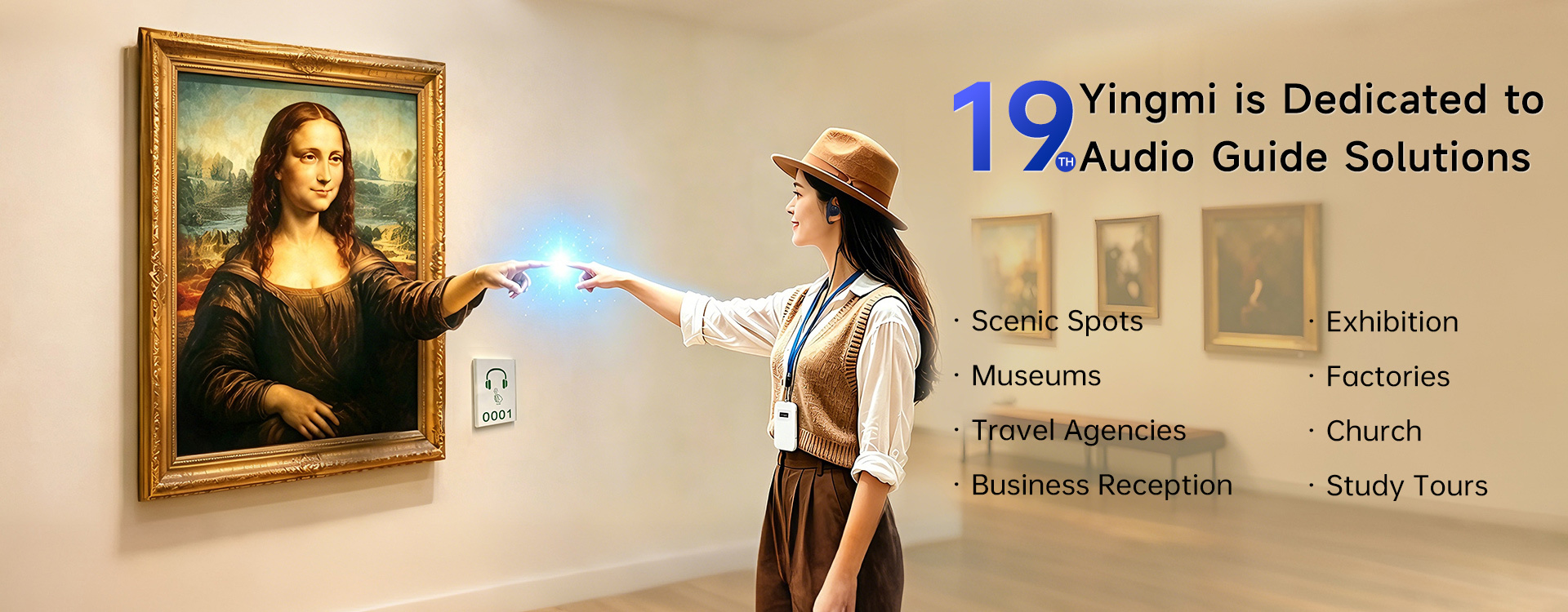
Galleries and private collections face an unusual version of the guided-tour problem. The rooms are quiet by design, the groups are small, and visitors want to look at their own pace. A loud guide breaks the atmosphere, and a printed label leaves most of the story untold. A self-guided audio guide system offers a middle path: each artwork can speak when the visitor arrives, in the visitor's ear and at the visitor's own speed, without anyone in the room raising their voice. This article walks through how that works for a gallery or a private collection, and what to plan before the first visitor puts on a device.
What a Label Cannot Do
Wall labels are short on purpose. They give the artist, the title, the date and the medium, and perhaps a sentence of interpretation. The richer material sits elsewhere: how the work was made, who owned it, why it matters in the collection, what the artist said about it. Audio is the natural home for that material, because it adds depth without adding clutter to the walls. Visitors who want only the basics can skip the audio, and visitors who want more can stay as long as they like.
Letting the Artwork Start Talking
The most visitor-friendly way to deliver audio in a gallery is to tie it to location. When a visitor walks up to a work, the right segment starts on its own, and when they leave it stops. There is no number to key in, no screen to tap and no map to consult. That matters in a space where people are looking at the art, not at their device. A visitor who has to look down at buttons has stopped looking at the painting.
Location-based triggering works with trigger points placed at or near each work. The receiver recognizes the point as the visitor approaches and plays the matching segment. This is the approach used by the YingMi M7, which is built around RFID trigger points rather than GPS, so it behaves the same way indoors as outdoors.
Public Gallery or Private Viewing
Setting
Typical visitors
What the audio should do
Public gallery
Many people, arriving at different times
Let each visitor move at their own pace with consistent content
Private collection by appointment
Small, invited groups
Add depth without a staff member on every visit
Temporary exhibition
Visitors who want context for new work
Be easy to update when the show changes
Corporate or hotel art collection
Guests and employees passing through
Be optional and unobtrusive
Writing for a Listener Who Is Looking
Audio for artworks works differently from a lecture. The visitor is already looking at the work, so the voice should help them see, not describe what is obvious. A few habits help:
Guide the eye. Point to what to look at: the light in the corner, the figure on the left, the texture of the surface.
Keep it short. A segment that outlasts the visitor's attention is skipped. Aim for what a person will stand still for.
Leave silence. A pause after the key idea gives the visitor time to look.
Plan every language from the start. International visitors are common, and adding a language later means touching every segment.
Trigger Points on a Gallery Wall
Placement matters more in a gallery than almost anywhere else. Works are often hung close together, and a trigger that fires too early or too widely can start the wrong segment. Before you decide how many points you need, ask the supplier how the trigger range behaves and how overlap between neighboring points is handled, and test it on a real wall. Also check what is acceptable where the work is displayed: in many collections nothing can be attached to a wall or frame, so freestanding or discreet placement may be the only option.
The M7 in a Gallery
YingMi M7
The YingMi M7 is a self-guided system that plays audio automatically when the visitor reaches a trigger point. It runs on 2.4GHz and supports up to 9,999 audio segments in 8 languages, enough for a large collection with a full set of translations. The trigger point battery is rated at 15 months or more, which keeps maintenance light across many galleries, and the receiver weighs 50g with an 800mAh battery rated at 16 hours or more, so it can be worn through a long visit without becoming a burden.
Handing Over the Device Gracefully
The first minute of the experience sets the tone. Give visitors a short, friendly explanation of how the receiver works and where it begins to play, then let them go. A private collection can make the handover a small ritual, with a staff member introducing the device and the collection together. A public gallery needs a clear, quick desk routine so queues do not form, with devices counted and cleaned when they come back.
Before Opening Day
1. Walk the route and mark where each work's trigger point will sit.
2. Test closely hung works for overlap and fix the placement.
3. Record and review every language with a native speaker.
4. Decide where devices are stored, charged and cleaned.
5. Plan how new works will be added without redoing the tour.
FAQ
Does self-guided audio replace a live guide?
Not necessarily. Many galleries use audio for everyday visitors and keep live guides for special tours and private viewings.
Can we use trigger points where nothing may be attached to the wall?
Often there are freestanding or discreet options. Check with your conservation or collections team before choosing locations.
How do we handle works that hang close together?
Ask the supplier how overlap between neighboring trigger points is managed, and test it on your own wall before you finalize placement.
How easy is it to change the content when an exhibition changes?
Plan for it from the start by keeping scripts and recordings organized by work, and confirm with the supplier how audio is updated.
View More
How Do Nature Reserves and Wetland Parks Run Guided Tours With a Tour Guide System?
2026-10-26
On a wetland boardwalk, a heron stands motionless thirty meters away. The guide wants the group to see it, but speaking loudly will send it into the air, and whispering means half the group hears nothing. This is the everyday problem of guiding in nature, and a tour guide system is one of the few tools that solves it directly.
Nature reserves and wetland parks live with a contradiction. Visitors come to learn about what they are seeing, and learning needs explanation, yet the best places to see wildlife are the ones where noise is least welcome. A guide who has to project over distance, wind and water disturbs the very thing the group came to watch. With a wireless tour guide system, the guide can speak at a low, natural volume while every visitor hears each word clearly in their own ear. This article looks at how that works in practice and what to consider when planning it for a reserve.
Quiet Voice, Full Attention
The most obvious benefit is also the most important one. When the sound goes directly to the listener, the guide no longer has to raise their voice to reach the back of the line. Wildlife is less likely to be startled, other visitors on the same boardwalk are less disturbed, and the group can stay still and watch without the guide having to wave or call. For birdwatching, in particular, the difference between a spoken whisper and a normal tone can decide whether the group sees the bird at all.
A Line of People Stretched Along a Boardwalk
Reserve layouts shape how groups move. Boardwalks and trails are narrow, which forces visitors into a long single line. By the time the guide reaches a viewpoint, the last people in line may still be fifty meters behind, out of normal speaking range. Wind, running water and the sound of the reeds make it worse. A wireless system keeps the whole line within reach of the guide, so the explanation arrives before the group reaches the view, not after it has moved on.
When choosing tour guide equipment for this kind of layout, check how far the signal reaches in an open, long, narrow space, because that is how your groups will actually be arranged. Test it on your own trails rather than relying on a number from a catalog.
Reading the Route Section by Section
A reserve visit is rarely uniform. Different sections of the route ask different things from the guide and from the equipment.
Route section
What happens there
What the guide needs
Boardwalk
Long single line, steady walking
Coverage along the whole line
Woodland path
Trees block sight, group spreads out
Stable signal through foliage
Open water edge
Wind and water noise, long sight lines
Clear voice over background sound
Observation hide
Small enclosed space, quiet required
Low-volume talk, easy to mute
Walking Pace and Watching Pace
A good reserve guide alternates between two rhythms. While walking, the guide gives short orientation notes: what is coming up, what to look for, how long until the next stop. At a viewpoint, the guide slows down, points out the subject and lets people watch. A tour guide system supports both. The walking notes reach everyone without anyone needing to catch up, and at the viewpoint the guide can describe what is in front of the group at a conversational volume, then go silent for a minute while people look. Plan the script around those two rhythms, with the longer explanations saved for where the group is standing still.
Several Groups, One Trail
Popular reserves often have more than one group on the same trail at once, especially at sunrise or in migration season. If all groups share a single channel, they hear each other's guides. A system with many channels lets each group tune to its own, so the explanation of the heron on one boardwalk does not drift into the ears of a group looking at something else. Give each group a channel when they receive their devices and let the guide confirm it at the first stop.
Why the L7 Suits Long Walks
YingMi L7
The YingMi L7 uses an ear-hook design, which stays comfortable over a long walk and is easy to put on without disturbing the group. It works on UHF with 150 transmit channels and 102 receive channels, so several groups can share a trail without overlapping. For a reserve, those two points matter most: comfort for visitors who are wearing the device for an hour or more, and enough channels to keep each guide's commentary to their own group.
Weather, Mud and Morning Dew
Reserves are damp, muddy and sometimes wet. Handling devices in that environment calls for a routine rather than a product claim. Keep devices in a dry case until the group arrives, hand them out under cover, and wipe them down when they come back. If your site has heavy rain, mist or salt air, ask the supplier directly what protection the equipment has, and do not assume. Ask about the whole kit, including the charging case and accessories, not only the receivers.
Before the First Dawn Walk
1. Walk each trail with a receiver and mark where the signal weakens.
2. Assign a channel to each group and tell guides before they set out.
3. Brief guides on keeping voices low and on muting the microphone in the hides.
4. Prepare a dry storage and return routine at the trailhead.
5. Charge all units the night before and keep a few spares.
FAQ
Does a tour guide system really reduce disturbance to wildlife?
It lets the guide speak at a low volume because the sound goes straight to each listener, so the guide does not need to project their voice across the group.
Will the signal work on a long boardwalk or through trees?
It depends on the system and the site. Test a receiver along each trail, including wooded sections, before you commit.
How do we keep groups on the same trail from hearing each other?
Give each group its own channel and confirm it at the first stop.
What should we ask about rain and humidity?
Ask the supplier what protection the receivers, charging case and accessories have, and get the answer in writing.
View More
How Do You Pick a Tour Guide System for a Study Tour With Students
2026-10-23
Thirty students, one guide, a crowded museum hall. The guide is explaining something important, but the students at the back are looking at their phones, and the one who actually has a question is too far away to ask it.
Study tours are a growing part of education travel, and they put unusual demands on audio guide equipment. The group is large, the attention span is short, the learners are young, and the whole point of the trip is that they understand and ask about what they see. Choosing a tour guide system for this setting is less about the longest range or the fanciest feature list, and more about whether it helps a teacher or guide keep a lively group together and engaged. This article explains what to look for.
Why a Study Group Is Not Just Another Tour Group
A typical sightseeing group listens. A study group is supposed to learn, which means it has to do more than listen. Students need to catch details, connect them with what they were taught, and ask when something is unclear. A guide who has to compete with the noise of a busy venue loses the quiet moments in which learning happens, and a system that only carries the guide's voice one way leaves out half of the exchange.
Study groups also tend to be in places that are noisy by nature: science museums, factories, historic districts and exhibition halls that are popular with other school groups at the same time. If several classes are in the same hall, the system has to keep each group's audio separate, or the guide's explanation ends up in someone else's ears.
Questions Are the Whole Point
The most important feature for a study tour is two-way communication. With a one-way system, the guide speaks and students listen. A student with a question has to walk up to the guide, raise a hand, or call out across the group, and many simply do not. With a two-way system, a student can speak and be heard by the guide, and the guide can answer so that the whole group hears. That small difference changes the character of the tour. Quiet students ask more when they do not have to shout in front of classmates, and the guide can check understanding as the group moves.
Two-way communication also helps with something less obvious: staying together. A teacher at the back of the line can speak to the guide at the front without stopping the tour, and a student who falls behind can be reached directly rather than waited for.
What the Equipment Has to Survive
Students are enthusiastic users, and equipment that works for adult tourists may not last a school trip. Look for a design that is light enough to wear all day, simple enough that a child can put it on without help, and sturdy enough to survive being dropped, pulled and pressed. Battery life matters as much as it does for any field trip: a unit that dies after lunch leaves half a day without audio. Also think about the handout and return routine. A class of thirty arriving at a venue needs a quick way to collect and count devices, and the teacher should not have to spend the first twenty minutes sorting them out.
Matching Needs to Features
What the tour needs
What to look for
Students can ask questions easily
Two-way communication between guide and group
Several classes in the same venue
Separate channels so groups do not overlap
A full day of activities
Battery life that covers the whole program
Noisy exhibits and crowded halls
Noise reduction on the microphone
Groups spread across a large site
Enough range to cover the route
Quick start and finish
Simple charging and an easy handout routine
How the 008S Fits a Study Group
YingMi 008S
The 008S supports two-way communication, so students can speak to the guide and ask questions during the tour instead of waiting for a break. Its dual-microphone ENC noise reduction helps voices stay clear in busy halls, and 20ms latency keeps the conversation natural, with no awkward delay between a question and its answer. It reaches 100m, enough to cover most museum floors and campus sites, and runs for about 10 hours from a 500mAh battery, charging over Type-C in about 2.5 hours, which suits a full day out with an overnight recharge.
Ground Rules for Young Users
A good system still needs a few rules to work well with students. Agree on when students may speak, so the channel does not fill with chatter. Tell them what the devices are for and what happens if one is lost or damaged. Assign a teacher or helper to oversee the return, and count devices at the end of each stop rather than at the end of the day. These habits are not about the technology itself, but they decide whether the tour feels organized or chaotic.
Before the Bus Leaves
1. Confirm the number of devices matches the group size, with a few spares.
2. Charge everything the night before and check each unit once.
3. Test two-way communication at the venue before the students arrive.
4. Brief the guide and teachers on how to use the speaking function.
5. Plan where devices are stored and charged during the trip.
FAQ
Do students really need two-way communication?
It is the most useful feature for a study tour. It lets students ask questions without calling out across the group, and it helps the teacher and guide stay in contact.
How many devices should we bring?
One for each student and accompanying adult who needs to listen, plus a few spares in case of faults or losses.
Can several school groups use the system in the same venue?
Yes, if the system provides separate channels. Confirm this with the supplier and test it at the venue.
How do we keep students from talking over the guide?
Agree on simple rules before the tour, such as who speaks and when, and let the guide invite questions at planned points.
View More
How Do You Choose Between Ear-Hook and Headset Receivers for a Tour Guide System
2026-10-22
At the same event, one guest says a headband flattens her hair, another says anything inside the ear feels unhygienic, and the guide just wants something that stays on for six hours. One tour guide system has to work for all of them.
Buyers usually compare range and battery life first, and the way the receiver is worn comes last. That order is backwards for the people actually using the equipment. A visitor will tolerate a slightly shorter range, but not an uncomfortable fit for two hours. How a receiver sits on the body decides how long people keep it on, how often you handle cleaning, and how fast you can turn units around. This guide compares the two wearing styles most tour operators end up choosing between, ear-hook and headset, and shows how to match them to your venue.
The Two Styles
Ear-hook. The receiver or speaker rests over the ear instead of inside it. It feels less invasive than an earbud, stays in place while the wearer walks, and is quick to put on and take off. It suits tours where visitors move around a lot and the equipment is handed out and collected repeatedly.
Headset. A head-mounted unit, often with a band. It is stable and comfortable over long sessions, and it is the usual choice for people who wear it for hours, such as interpreters and conference attendees following a full-day program. The trade-off is that it takes a little longer to adjust and can bother people with glasses or styled hair.
Side by Side
Factor
Ear-hook
Headset
Comfort over time
Good for tours on the move
Stable for long sessions
Putting on and taking off
Quick
Slower, needs adjusting
Hygiene handling
Easy to wipe down
Easy to wipe, band can hold dirt
Turnaround between groups
Fast
Moderate
Possible drawbacks
May feel loose if fit is poor
Can bother glasses or hairstyles
Matching the Style to the Situation
Short, walking tours with many different visitors. Ear-hook. Speed of handout and comfort over an hour matter most, and groups change constantly.
Full-day conferences and interpretation sessions. Headset. Stability and comfort over many hours matter more than speed, and attendees keep the unit on for long stretches.
Hygiene-sensitive settings. Both styles wipe down more easily than anything worn inside the ear. Ear-hook is quicker to clean between groups, which helps when units are reused many times a day.
Mixed audiences. Some guests will not like either style. Keeping a small number of the other type on hand avoids turning anyone away.
Two Examples From the YingMi Range
YingMi 008S: Head-Mounted
The 008S is worn head-mounted, which suits long sessions where stability matters, such as simultaneous interpretation. It has dual-microphone ENC noise reduction, 20ms latency and about 10 hours of battery life, so a full conference day is covered by one charge.
YingMi L7: Ear-Hook
The L7 uses an ear-hook design, which is quick to put on and comfortable for visitors on the move. It works on UHF, with 150 transmit channels and 102 receive channels, which suits venues running several groups at once.
Do Not Forget Cleaning and Wear
The wearing style also decides what you will be maintaining for years. Ear hooks, headbands and pads wear out and need replacing, and they are not always supplied for as long as the main unit. Ask what is replaceable and what can be wiped. Decide who cleans the units, when, and with what, before the first event rather than after the first complaint. A simple wipe-down routine at the return desk handles most hygiene concerns without slowing the queue.
Offer a Choice Where You Can
The simplest answer to varied preferences is a small mix: a main style for most guests and a few of the other for those who cannot use it. Ask early, at registration or at the handout desk, rather than after someone has struggled with the wrong fit.
FAQ
Which is better for a walking tour, ear-hook or headset?
Ear-hook is usually the better fit. It goes on quickly, stays in place while walking and turns around fast between groups.
Which style suits a full-day conference?
A headset, because it stays stable and comfortable over many hours.
Can we mix both styles in one fleet?
Yes, as long as the units work on the same system. Confirm compatibility with your supplier before buying.
How should we clean receivers between groups?
Wipe the parts that touch the skin with a suitable cleaning wipe at the return desk, and check the manufacturer's care guidance first.
View More
What Should You Budget for Spare Units in a Tour Guide System
2026-10-21
It is ten minutes before the group arrives. Three receivers will not power on, one has a cracked case, and one never came back from yesterday's tour. The guide counts what is left and realizes the order was sized for the group, not for the day.
Spare units are the least exciting line in a tour guide system budget and the first one people regret cutting. A fleet that is exactly the size of your largest group has no margin for the ordinary things that go wrong: a battery that does not charge, a unit dropped on a stone floor, a visitor who walks out with a receiver in a coat pocket. This article explains how to think about spares, how to estimate a sensible number for your own operation without relying on a rule of thumb, and how to manage them once you own them.
Where Spare Units Actually Go
Before choosing a number, it helps to know what will consume the spares. In practice there are four drains, and each one behaves differently.
Charging problems. A unit that did not charge overnight, a dock slot with a poor contact, or a battery that has aged. These show up on the morning of an event.
Physical damage. Drops, spills, crushed lanyards and cracked housings. More likely when units are handed to large, busy groups.
Loss. Receivers that are not returned, or are returned to the wrong place. More likely at open-access venues and at events where visitors keep moving.
Time in repair. A unit sent for service is unavailable until it comes back. The longer the repair turnaround, the more spares you need to cover the gap.
A Way to Estimate Your Own Number
There is no universal percentage that fits every operation, and a number borrowed from another venue may be badly wrong for yours. A better approach is to work from your own conditions. Start with the largest group you expect to serve in a single session. Then ask three questions.
1. How often do you run? A venue running daily tours wears units faster and has less time to recover between sessions than one with a few events a year.
2. How long does a repair take? If a unit sent for service is gone for weeks, every faulty unit stays out of your fleet for that long. Longer turnarounds call for more spares.
3. How costly is a shortfall? A corporate reception for senior guests or a booked international delegation cannot tolerate a missing receiver. A casual public tour can. The cost of being short sets how much margin is worth paying for.
Keep a simple log for the first few months: units that failed, were damaged or went missing, and how long each was unavailable. After a season, your own records give a far better estimate than any rule of thumb.
Different Operations, Different Margins
Operation
Main risk to spares
What to prioritize
Daily public tours
Wear, loss, battery aging
Margin for loss and a rotation plan
Occasional large events
Units idle between events, failing on day one
Pre-event testing and spares ready to use
Government and corporate receptions
Zero tolerance for a missing unit
Generous reserve, tested and labeled
Multi-site operators
Units stranded at the wrong site
A shared pool or spares at each site
Long repair turnaround
Faulty units out of service for weeks
Larger reserve, or advance replacement terms
Managing the Spares Once You Own Them
Spare units only help if they are ready when needed. A few habits make that dependable.
Rotate, do not hoard. A spare that sits unused for a year is the one most likely to have a flat battery or an outdated setting. Cycle spares into regular use so wear is spread across the fleet and every unit is exercised.
Number everything. Labeled units make it easy to see which ones fail repeatedly, which have gone missing, and which are on loan.
Keep spares charged and tested. Include them in the nightly charging routine and in the pre-event check, so a spare is a unit you know works.
Store them with the fleet. A spare in a drawer across the building is not a spare when the group is waiting. Keep reserves in the same case or station as the main set.
Charging and Storage Are Part of the Spare Plan
How you charge and store the fleet affects how many spares you need. A case or dock that holds a full set plus reserves keeps everything in one place and makes it obvious when a slot is empty. Poor charging contacts or a mixed collection of cables create exactly the quiet failures that consume spares on the morning of an event. When you plan a fleet, size the charging and storage together with the units.
YingMi L8: Kits With Charging Built In
The YingMi L8 is offered in kits from small groups up to larger sets, with charging docks and charging boxes included as part of the setup. A 2.5-hour charge against 6 to 8 hours of working time keeps overnight turnaround realistic, and the 16g receiver and 98g transmitter are light enough to hand out and collect repeatedly. When choosing a kit, count your spare units as part of the size, so the case or dock you buy has room for them.
The Practical Takeaway
Budget for spares the way you would budget for any buffer: sized to the risk you face, not to a number someone else used. Know where units get consumed, track your own failures for a season, and match the reserve to how costly a shortfall would be. A small, well-managed set of spares is cheap compared with a morning of apologizing to a waiting group.
FAQ
Is there a standard percentage of spares to buy?
No single figure fits every operation. Base the number on your tour frequency, repair turnaround and the cost of a shortfall, then adjust using your own failure records.
Should spares be kept separate from the main fleet?
Store them together so they are quick to reach, but label them and rotate them into regular use so they stay tested and charged.
How does repair turnaround affect the number of spares?
The longer a faulty unit is away, the longer it is missing from your fleet, so slower repairs call for a larger reserve. Ask your supplier about turnaround before you buy.
How can we reduce losses at open-access venues?
Use a clear handout and return routine, number each unit, and keep a record of who has which receiver during each tour.
View More